Project 05
Introducing AI to Search
Role
Design lead
Team
4 designers
Year
2026
Platforms
Web and app
Key learnings
Less is more
Trying to fit too much in only crowded the designs. Every element had to earn its place.
One clear path
Cutting back the number of CTAs stopped customers feeling overwhelmed and led them down fewer, stronger paths.
Don’t force the AI
The AI summary is offered as an option, with traditional search results still below for anyone who prefers them.

Introduction
Brought in to lead the vision
In 2026, a new project landed on my plate. It came in through OKRs, requested by the Product and Design Leads of both the Search Tribe and the Help Tribe: a vision piece for bringing AI into search.
Four of us took it on: me, a Conversational Designer I work closely with on Aimee, and a Product Designer and Content Designer from the search team. I was asked to lead it, drawing on my AI experience from previous vision projects and the range of journeys I’d designed across Aimee. With the senior designer on my team at capacity, it was my chance to step up.
It’s one of the projects I’m proudest of, both for the chance it gave me to lead and for how granular and thorough we got with the designs.
Discovery
Mapping how others use AI in search
Discovery was huge. Several of us were researching at the same time, pulling everything into one shared Mural board. My part was supporting my manager with competitor research.
We gathered designs from big names that have seen real success with AI search, like Reddit, Argos and Amazon, and I dug deep into smaller start-up apps too. From that we built a table of around 15 companies, comparing how each one uses AI in search and showing where the most common AI features appear.
Alongside the competitor analysis, we looked at internal data and existing user research, EE’s current search performance, and market insights, including demo calls with AI search platforms such as Accenture and Algolia.
Discovery board · Mural

Discovery board: Showing competitor research
Workshop
Bringing the team into one room
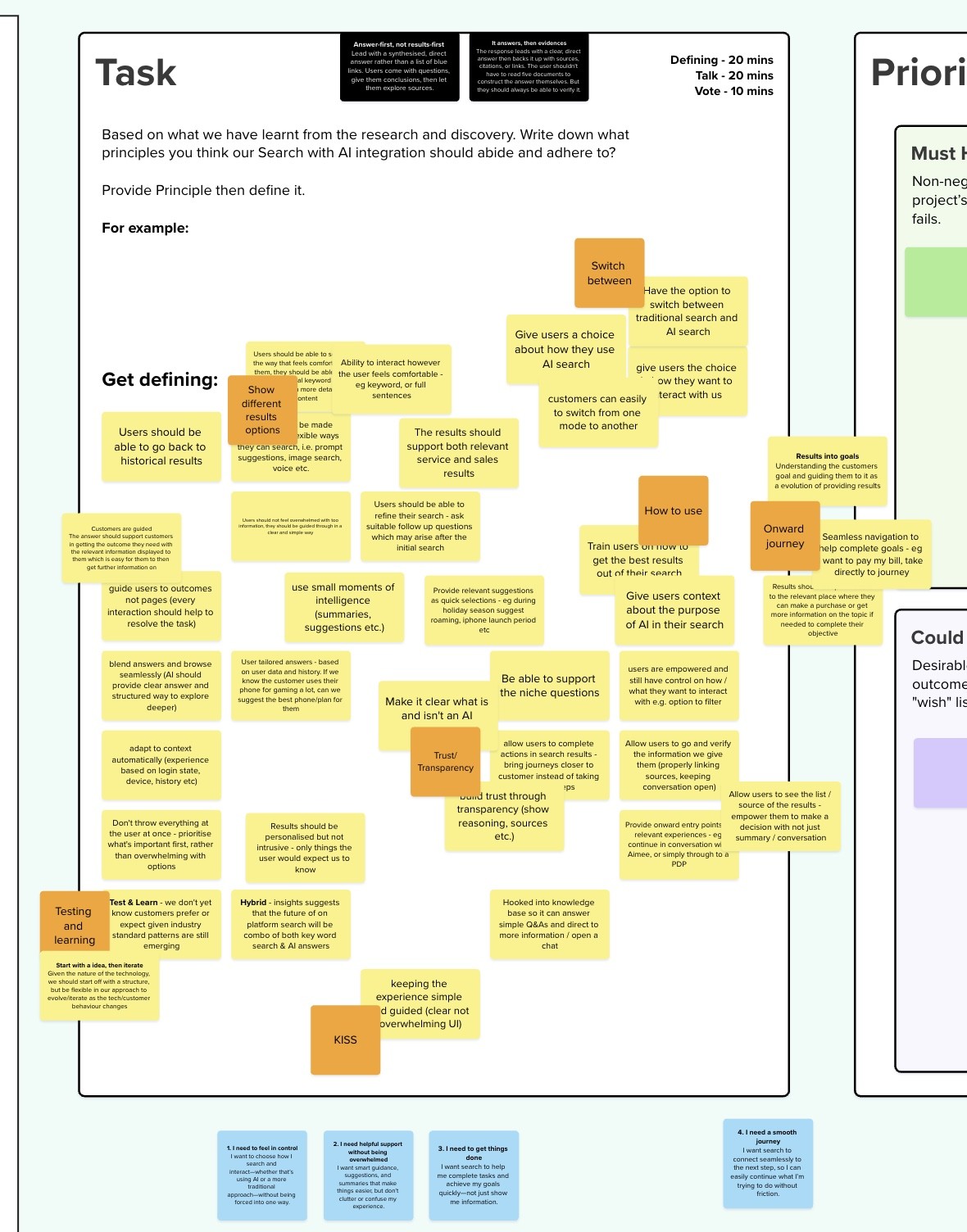
Once discovery was wrapped up, we brought everyone together for an in-person workshop with all the designers and a few of the design managers.
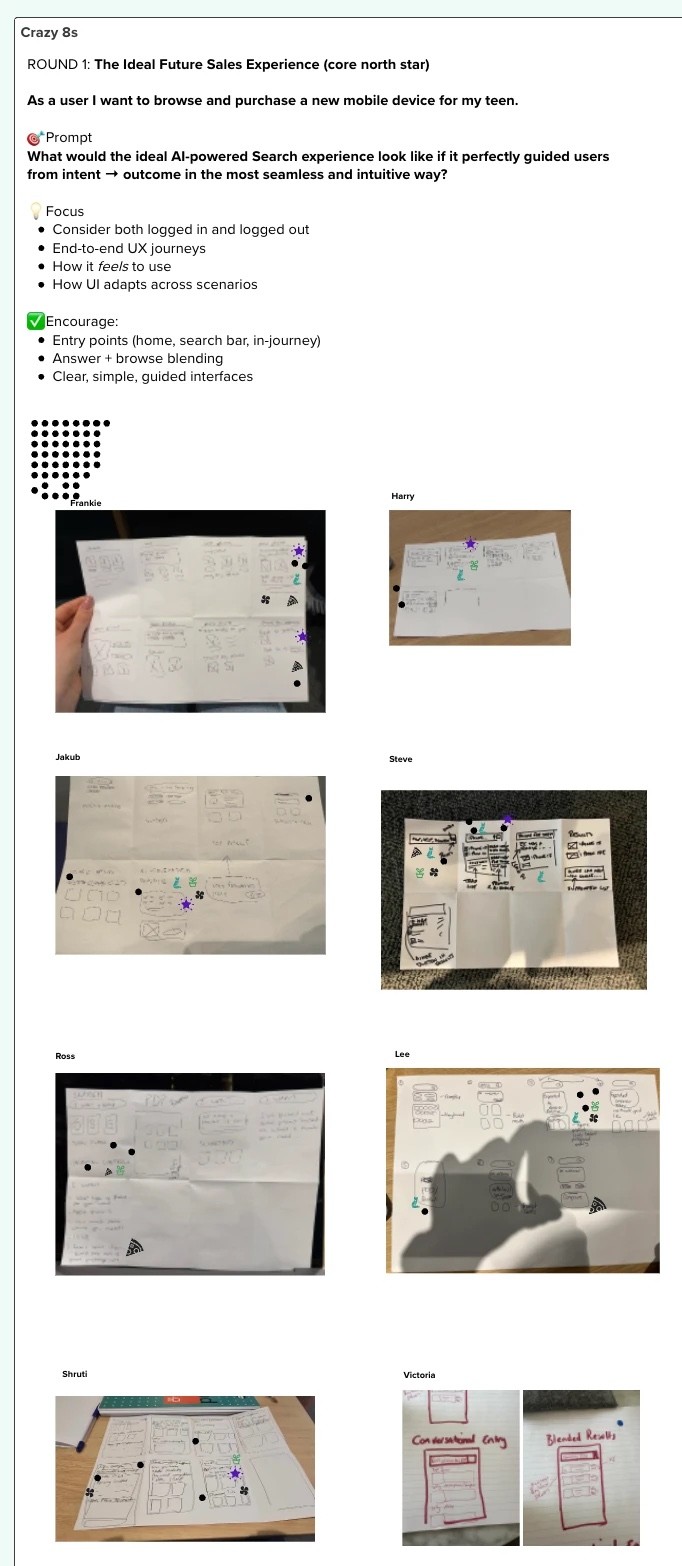
Over the day we grouped our research and findings into themes, defined the project’s key principles and ran several rounds of Crazy 8s, each aimed at a different prompt. We then walked through everyone’s ideas together and picked out the key concepts that could work best for the project.

Initial designs
01
Start broad
I began without thinking about technical constraints, just exploring what a journey like this could look like.
02
A personalised questionnaire
My mind went straight to a short questionnaire that helps customers find the perfect phone for them, one simple question at a time.
03
Shaped by their account
Background data from their account refines the choices, so the conversation already knows how they use their phone and their data.

Step 1 · What matters most to you?
Designing for how people really search
After the early explorations, I was asked to focus on roaming, and how AI search could create a genuinely happy experience for customers heading abroad.
Rather than a simple query like “Roaming” or “Roaming Spain”, we designed around a detailed, conversational prompt, the kind people now type thanks to AI chatbots. The customer names a city rather than a country, gives a number of days and asks what it will cost. That’s several questions in one, so the AI summary combines them into a single conversational answer that covers everything they need.
Behind the scenes, the AI checks the customer’s current plan: whether roaming is already set up as an add-on, or whether they’d need a mix of passes and daily charges.
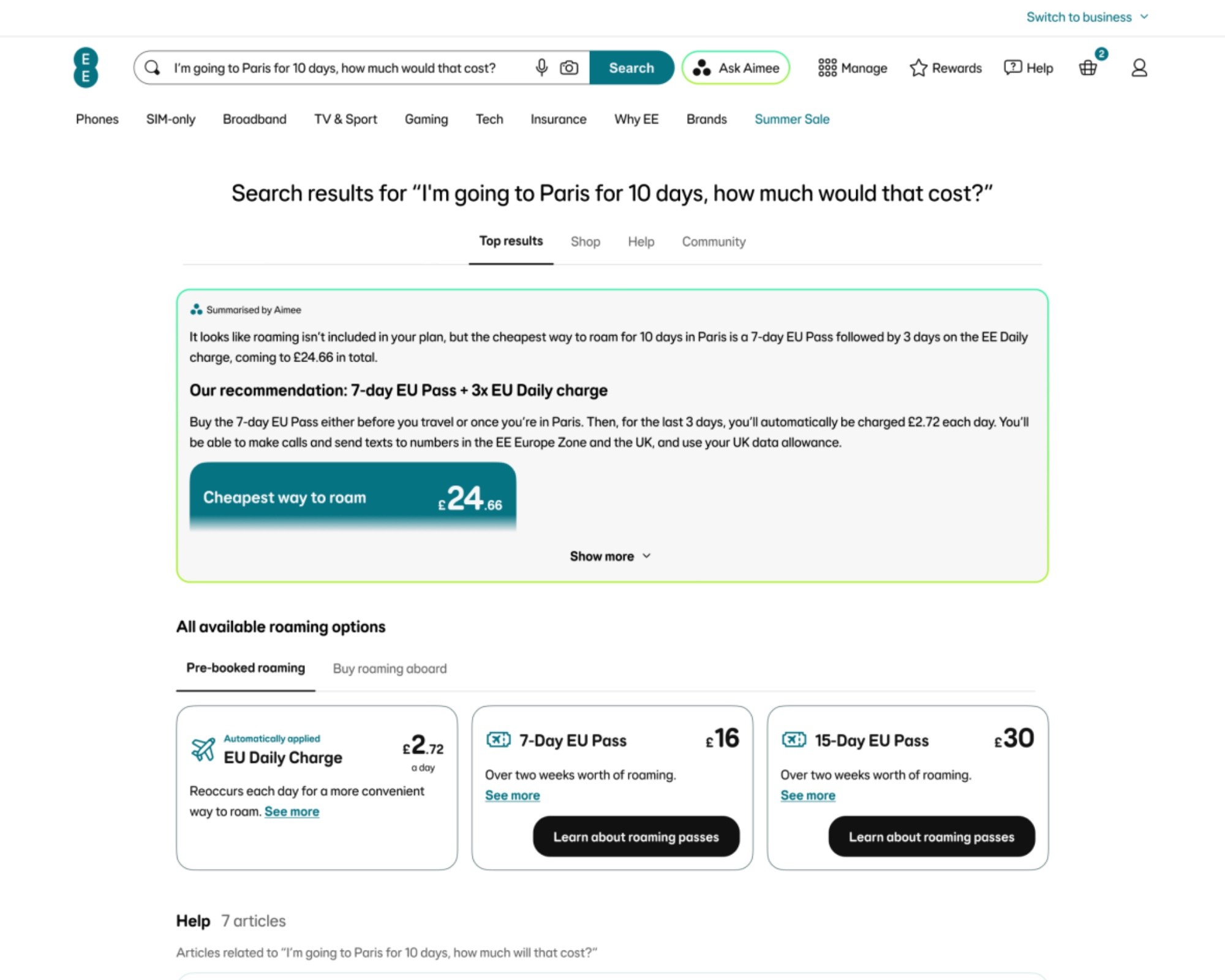
1 · The AI summary
We also brought in Quick Replies from Aimee to keep things consistent. With GenAI, these become tailored prompts unique to the customer’s account and what they’ve typed. Tapping a Quick Reply or the Ask Aimee button opens a sheet on the right of the screen.
That sheet went through a few rounds of internal testing. Our first version took over the whole screen, but we planned to make it a global component that could also open from the top navigation on any page. Making that call early meant we wouldn’t have to rework the designs later.


Moving from a full page to a side sheet let Ask Aimee become a global component, ready to open from the top navigation.
The designs then went through stakeholder reviews, were refined, and were brought to life in an animated prototype.
Throughout, we worked closely with the Roaming design team to make sure the journey worked for customers and that every piece of information we showed was correct. Their feedback was really positive, and they gave the final designs the all clear.
Final outcome
Working prototypes, built for web and app
To bring the vision to life, I built working prototypes and recorded them to show each journey clearly. The AI summary sits at the top and can be expanded, while the existing search components stay underneath for customers who’d rather search the traditional way.
Keeping those components drew some pushback in crit sessions, as it can look like duplication. Using user research, I showed that not everyone is willing to use AI, and many still prefer a traditional search experience, so keeping both gives those customers an effective route too.
Not everyone wants AI. Keeping traditional results means nobody is forced into it.
As the videos show, the designs hold up across both web and app, with every component working seamlessly in each.
Roaming journey · Web and app
Shop journey · App
I also linked back in with the search team, who were designing a Shop journey for a customer buying an iPhone for their teenager. I took over the final adjustments to keep both journeys consistent and make the Shop experience as strong as roaming.
We presented the work to Directors, where it received great feedback and I was recognised for my part in it.
This was the first large project I’ve led with multiple designers. It showed I can take a team from research and workshops through to a vision Directors responded to, and that I understand where AI genuinely helps customers and where it gets in the way.
Open to new product design roles. Say hello.
© Harry Thorpe · 2026
DesignED with FRAMER